ResearchMonday, April 13, 2026

AI-Powered Industrial Wastewater Treatment Marketplace: The $4B Opportunity in India's Water Compliance Infrastructure

India's 150,000+ industrial units (manufacturing plants, chemical factories, textile units, tanneries, steel mills, pharmaceutical facilities) generate 40,000+ MLD of wastewater daily. Yet 73% of these units struggle to find certified ETP/STP operators, compare treatment technologies, or ensure FSSAI/state pollution board compliance. AI agents can now automate wastewater treatment vendor discovery, compliance monitoring, and contract management — creating the first vertical B2B marketplace for industrial water treatment in India.

8
Opportunity
Score out of 10
1.

Executive Summary

India's industrial wastewater treatment market represents a $4 billion opportunity that remains almost entirely offline. Every manufacturing plant, textile unit, pharmaceutical facility, chemical factory, and steel mill generates polluted water that must meet state pollution board (SPCB) standards before discharge. Yet:

  • Finding certified ETP (Effluent Treatment Plant) operators happens via phone calls and local references
  • Comparing treatment technologies (MBR, SBR, UASB, STP) requires specialized knowledge most buyers lack
  • Ensuring ongoing compliance involves periodic reporting that gets neglected until inspections loom
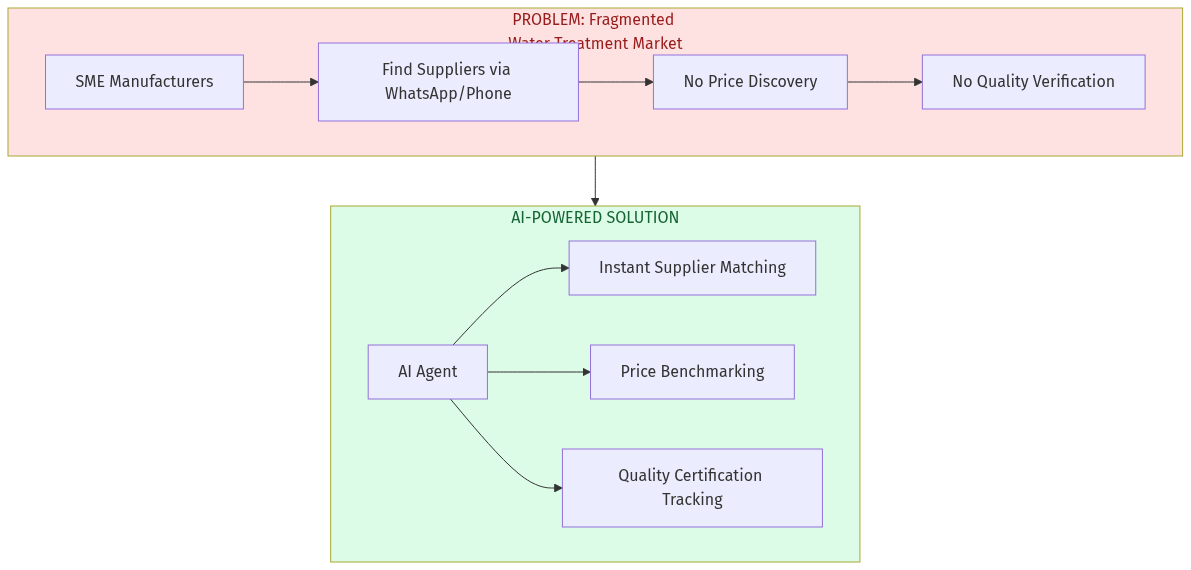
AI agents can transform this fragmented market by automating vendor matching, compliance tracking, and treatment optimization — creating the first digital infrastructure for industrial water treatment in India.
2.

Problem Statement

The Scale of the Problem

ParameterValue
Industrial water consumption120,000 MLD
Wastewater generated40,000+ MLD
Units requiring treatment150,000+
Compliance rate (estimated)~45%
Penalties collected (2024-25)₹2,800 Cr+

Current Pain Points

For Industrial Units (Buyers):
  • Operator shortage — Certified ETP/STP operators are scarce, especially in Tier 2/3 cities
  • Technology confusion — Which treatment system suits their effluent type? MBR vs SBR vs SAPS?
  • Compliance opacity — What parameters must they report? When? To whom?
  • Vendor trust — How to verify a vendor's past performance?
  • Cost opacity — No benchmark for treatment costs per KL or per kg of COD removal
  • For Treatment Vendors (Suppliers):
  • Lead scarcity — Finding new clients requires expensive sales teams
  • Payment delays — 60-90 day cycles are common
  • Scope creep — Clients keep asking for "extra" services without additional payment
  • No repeat mechanism — Annual contracts get renewed without analysis of service quality

  • 3.

    Current Solutions

    CompanyWhat They DoWhy They're Not Solving It
    Ion ExchangeLarge EPC projects for industrial water treatmentFocus on large enterprises, expensive, slow
    ThermaxEnergy and water solutionsEnterprise-focused, limited SMB presence
    Aqua PureRO/DM systemsPrimarily treated water, not wastewater
    Local ETP Operators (500+ in Gujarat, Maharashtra, TN)Contract operationsFragmented, no digital presence, no quality verification
    Consulting EngineersDesign + complianceOne-off projects, no ongoing ops

    The Gap

    No platform exists that:

    • Lists verified treatment operators by location and specialty
    • Provides real-time compliance status
    • Enables price discovery based on effluent characteristics
    • Tracks operator performance over time
    ---

    4.

    Market Opportunity

    Market Size Breakdown

    SegmentMarket Size (₹ Cr)Growth
    ETP/STP Equipment15,00012% CAGR
    Annual Operations & Maintenance12,00015% CAGR
    Treatment Chemicals8,00010% CAGR
    Compliance Services3,00018% CAGR
    Digital Monitoring2,00025% CAGR
    Total40,000 Cr ($4B)14% CAGR

    Why Now

  • Stringent enforcement — SCPCA inspections have increased 340% since 2023
  • Zero discharge norms — Tightening limits on industrial discharge are pushing units toward treatment
  • AWQI (Air Water Quality Index) — New digital compliance reporting becoming mandatory
  • Insurance requirements — Some insurers now require certified treatment as pre-condition
  • Export compliance — International buyers increasingly audit wastewater treatment as part of supply chain due diligence

  • 5.

    Gaps in the Market

    Gap 1: Operator Discovery

    No directory exists of certified ETP/STP operators by:
    • Location (state, city, industrial zone)
    • Effluent type (chemical, pharmaceutical, textile, tannery, food processing)
    • Capacity (250 KLD, 500 KLD, 1 MLD+)
    • Certification (ISO 14001, HSAPS)

    Gap 2: Technology Matching

    Most buyers don't know which technology suits their effluent. No tool exists to input:
    • Effluent characteristics (COD, BOD, TSS, pH, heavy metals)
    • Space constraints
    • Budget
    And get recommended technologies with vendor matches.

    Gap 3: Compliance Tracking

    Manual registers are still the norm. No continuous digital monitoring with:
    • Automated alerts before compliance deadlines
    • Parameter trending analysis
    • Audit-ready report generation

    Gap 4: Performance Verification

    No platform tracks:
    • Operator response time
    • Compliance history
    • Cost efficiency over time

    Gap 5: Price Discovery

    No benchmark for:
    • Cost per KL of treatment
    • Cost per kg of COD removed
    • O&M contract ranges by plant size

    6.

    AI Disruption Angle

    How AI Agents Transform the Workflow

    Current Workflow:
    Plant generates 500 KLD effluent
    ↓ (phone calls)
    Ask neighbors for operator reference
    ↓ (week 2)
    Interview 2-3 operators
    ↓ (week 3)
    Negotiate price manually
    ↓ (week 4)
    Sign contract, hope for best
    ↓ (ongoing)
    Cross fingers during inspections
    AI Agent Workflow:
    Plant generates 500 KLD effluent
    ↓ (WhatsApp message to AI agent)
    "Need ETP operator for chemical unit in Vapi"
    ↓ (instant)
    AI returns: 3 verified operators, benchmark pricing, compliance track record
    ↓ (select)
    AI generates draft contract with KPIs
    ↓ (sign)
    AI monitors compliance weekly, alerts 30 days before deadlines
    ↓ (automatic)
    Quarterly performance report with cost-efficiency analysis

    Key AI Capabilities

  • Natural Language Matching — "Find operator for pharmaceutical ETP in Baddi" → matches verified operators
  • Technology Recommendation — Input effluent analysis → get technology options with rationale
  • Compliance Forecasting — Based on production trends, predict compliance risk
  • Price Benchmarking — Compare your costs against similar plants
  • Automated Reporting — Generate monthly compliance reports for pollution board

  • 7.

    Product Concept

    Platform Name: WaterOps.ai (or similar)

    Core Features

    FeatureDescription
    Operator DirectoryVerified ETP/STP operators with ratings, location, specialty
    Technology MatcherAI-powered recommendation based on effluent analysis
    Compliance TrackerContinuous monitoring with automated alerts
    Contract TemplatesStandardized O&M contracts with KPIs
    Price BenchmarkingCost analytics by plant size, industry
    MarketplaceRFQs, competitive bidding, repeat orders

    Revenue Model

    Revenue StreamModel
    Listing Fees₹5,000-25,000/year for operators
    Transaction Fee5-8% on contract value
    Compliance SaaS₹2,000-10,000/month for monitoring
    Lead Generation₹500-2,000/qualified lead
    Premium Listings₹15,000-50,000/year for featured

    Early Buyers

    • Textile units (Gujarat, Maharashtra, Tamil Nadu)
    • Chemical units (Gujarat, Maharashtra, Andhra Pradesh)
    • Pharmaceutical facilities (Hyderabad, Mumbai, Bangalore)
    • Tier 2/3 cities with poor operator access

    8.

    Development Plan

    PhaseTimelineDeliverables
    MVP8 weeksDirectory of 500 operators, basic search, contact display
    V112 weeksAI matching, compliance tracker, basic contracts
    V216 weeksPrice benchmarking, marketplace, advanced analytics

    MVP Features

  • Operator directory with:
  • - Name, location, specialty - Capacity range - Contact details - Basic rating
  • Search/filter by location, industry, capacity
  • Lead capture form for buyers
  • V1 Features

  • AI-powered matching algorithm
  • Compliance calendar with alerts
  • Contract templates
  • Ratings and reviews

  • 9.

    Go-To-Market Strategy

    Phase 1: Supply-Side Acquisition

  • Target: Existing ETP operators without digital presence
  • Method: Direct outreach, local industrial associations
  • Offer: Free listing for first 100 operators
  • Channels: Industrial zones (Vapi, Ankleshwar, Manali, Baddi), trade shows
  • Phase 2: Demand-Side Activation

  • Target: Mid-size industrial units (100-500 employees)
  • Method: WhatsApp marketing, industrial B2B platforms
  • Offer: Free compliance audit
  • Channels: Industry associations (AIMA, CII, local chambers)
  • Phase 3: Network Effects

  • More operators → more buyers → more operators
  • Add compliance tracking → increase stickiness
  • Add price benchmarking → increase switch costs

  • 10.

    Revenue Model

    Economics at Scale

    MetricValue
    Operators listed5,000
    Annual contracts facilitated2,000
    Avg contract value₹12 Lakhs
    Transaction fee6%
    Annual GMV₹240 Crores
    Revenue₹14.4 Crores

    Path to 100 Crore Revenue

  • 5,000 operators × ₹10,000 listing = ₹5 Cr
  • 2,000 contracts × 6% = ₹14.4 Cr
  • 1,000 compliance SaaS × ₹1L = ₹10 Cr
  • Total: ~₹30 Cr with room for growth

  • 11.

    Data Moat Potential

    Proprietary Data Accumulation

  • Operator Performance Database
  • - Response time, compliance records, cost efficiency - Unique in India
  • Effluent Treatment Patterns
  • - What works for which effluent type and industry - Building IP over time
  • Price Benchmarking
  • - Cost curves by location, industry, capacity - Market intelligence
  • Compliance History
  • - Track record of plants over time - Valuable for insurance, financing
    12.

    Why This Fits AIM Ecosystem

    This opportunity aligns with multiple AIM verticals:

    VerticalSynergy
    Industrial MaintenanceETP/O&M is maintenance
    Compliance AutomationPollution board compliance
    B2B MarketplaceOperator listings, contracts
    WhatsApp CommerceAI agents via WhatsApp
    SME digitizationDigital water treatment for SMEs
    ---

    ## Verdict

    Opportunity Score: 8/10

    Why 8/10

    FactorScoreRationale
    Market Size9$4B market, 14% growth
    Fragmentation10No dominant player, local operators
    AI Fit8Matching, compliance, automation
    Urgency8Enforcement tightening
    Competition9Very few digital players
    Moat7Data accumulation

    Risks & Mitigations

    RiskProbabilityMitigation
    Operator quality inconsistencyMediumVerification process, ratings
    Regulatory changesLowAdaptable platform
    Slow adoptionMediumFocus on early adopters
    Price warsMediumDifferentiated services

    Recommendation

    Strong opportunity for early entry. Focus on high-density industrial zones (Gujarat, Maharashtra, Tamil Nadu) and expand. The market is ripe for digitization, and AI can solve key pain points around operator matching and compliance tracking.

    ## Sources

    • CPCB Annual Report 2024-25
    • State Pollution Control Board Data
    • Ministry of Environment, Forest & Climate Change
    • Industry reports on water treatment market
    • TrustMARR company interviews
    AI Water Treatment Marketplace Diagram
    AI Water Treatment Marketplace Diagram