ResearchMonday, April 13, 2026

AI-Powered Supply Chain Finance for Indian SMBs: Unlocking the $500B Working Capital Gap

India's 75 million SMBs face a $500 billion working capital crisis — trapped between buyers who pay in 60-90 days and suppliers who demand instant payment. AI agents can now solve this by automating reverse factoring, enabling instant financing against approved invoices, and creating the first digital supply chain finance marketplace in India.

1.

Executive Summary

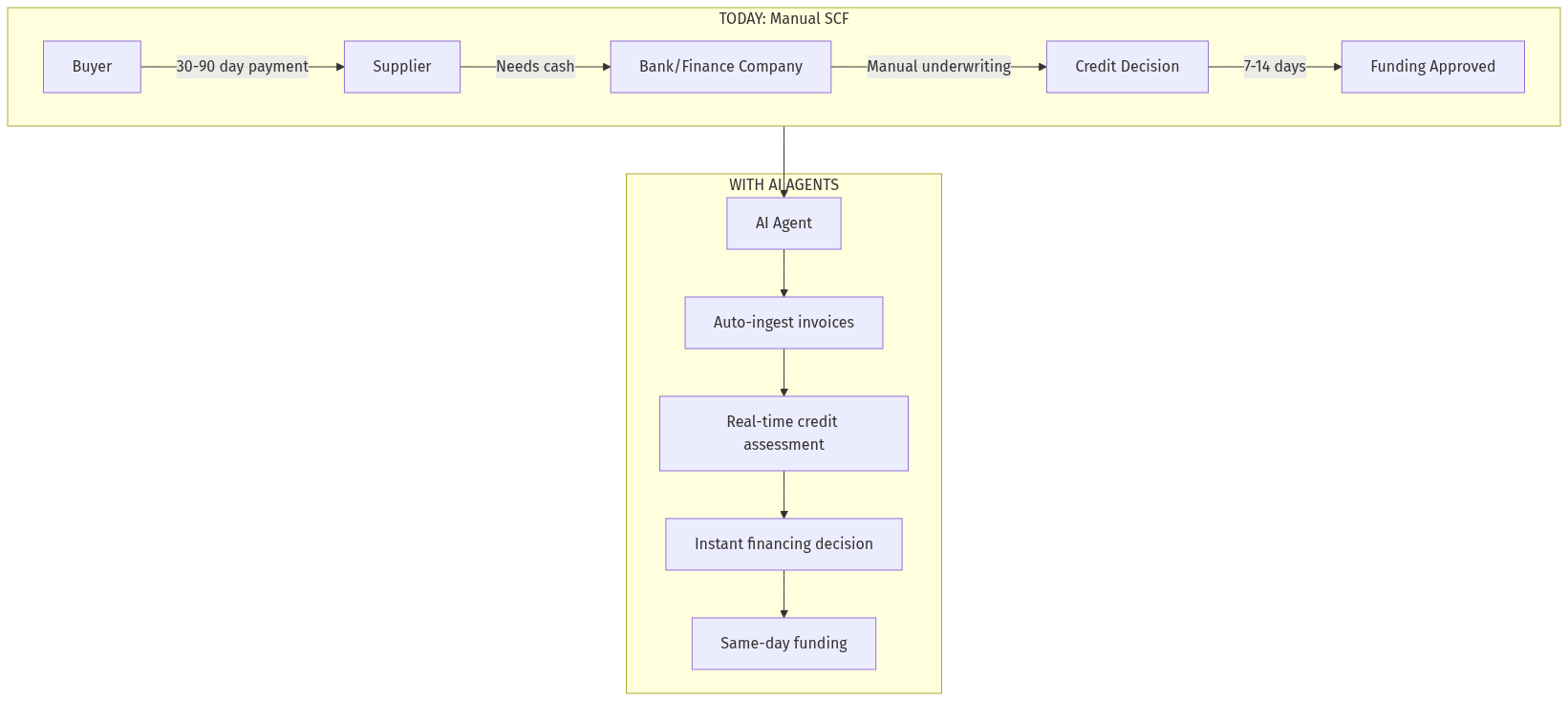
Supply Chain Finance Flow: Today vs AI

India's SMB ecosystem is suffocating under a hidden crisis: working capital starvation. Large buyers — retailers, manufacturers, hospital chains, hospitality groups — demand 60-90 day payment terms. But their suppliers (SMBs) must pay workers, buy raw materials, and fulfill orders immediately. This timing mismatch creates a $500 billion gap that no traditional bank has solved.

Supply Chain Finance (SCF), also known as reverse factoring, solves this by allowing buyers to validate supplier invoices, enabling financiers to pay suppliers early at rates tied to the buyer's credit rating (not the supplier's). But SCF in India remains limited to large corporations with dedicated treasury teams. SMBs are excluded.

This article presents the opportunity to build an AI-powered SCF platform that:

  • Auto-discovers invoice opportunities from e-invoicing data
  • Provides instant credit decisions using alternative data
  • Enables same-day financing for approved invoices
  • Reduces financing costs by 40-60% vs current informal lending
---

2.

Problem Statement

The Working Capital Vise

Every Indian SMB founder knows this story: You land a big client (hospital chain, restaurant group, manufacturer). They promise ₹50 lakh in orders per month. Then you see the payment terms: "Net 60 days." Your supplier needs payment in 7 days. Your labor needs wages weekly. The math doesn't work.

Current outcomes:
  • Personal funds exhausted — Founders borrow from family, NBFCs at 24-36% p.a.
  • Growth stunted — Can't accept orders because no working capital
  • Supplier relationships damaged — Delayed payments lead to quality issues or blacklisting
  • Bank rejection — Traditional banks reject SMBs without property collateral

The Gap in Numbers

MetricValue
Total SMB working capital gap in India~$500B
SMBs with access to formal credit<20%
Average payment delay (large buyer to SMB)60-90 days
Interest rate on informal NBFC loans24-36% p.a.
Interest rate on SCF (buyer-linked)8-14% p.a.

Why Current Solutions Fail

Traditional Banks:
  • Require 2-3 years of audited financials
  • Collateral (property) mandatory for credit >₹10 lakh
  • 4-8 week turnaround for credit decisions
  • SCF products exist but only for crore-plus turnover companies
NBFCs:
  • Faster but expensive (24-36% p.a.)
  • Personal guarantees required
  • No link to actual invoice dynamics
Buyer-led SCF Programs:
  • Only available in large conglomerates with treasury teams
  • Manual, paper-heavy onboarding
  • Minimum ticket sizes of ₹50 lakh+

3.

Current Solutions

CompanyWhat They DoWhy They're Not Solving It
C2FOGlobal SCF platformEnterprise-focused, India presence limited
TauliaHSBC-backed SCFFortune 500 only, prohibitive for SMBs
PrimeFinIndian SCFManual processes, limited reach
KredXInvoice discountingFocus on large corporates, not SMB supply chains
Airtel FlexiBusiness loansNot linked to actual invoice dynamics
LendingkartSMB working capitalGeneric term loans, not SCF

Industry Structure

The Indian SCF market is dominated by:

  • Banks (HDFC, ICICI, Yes Bank) — SCF products but enterprise-only
  • Foreign banks (Citi, HSBC) — Cross-border SCF for MNC suppliers
  • Fintechs (KredX, Vyjal) — Invoice discounting but transaction-based, not platform-based
Gap: No AI-native SCF platform specifically targeting the long tail of SMB suppliers in India.


4.

Market Opportunity

  • Total Addressable Market: $500B (estimated working capital gap for Indian SMBs)
  • Serviceable Addressable Market: $50-100B (SMBs with B2B relationships and e-invoicing capability)
  • Current SCF penetration in India: <5% of addressable market
  • Growth drivers:
- GST and e-invoicing creating digital invoice trails - UPI/credit infrastructure enabling instant payments - RBI pushing for supply chain finance digitization - PLI scheme manufacturing driving new B2B relationships

Why Now

  • E-invoicing mandate — Since 2023, businesses >₹5Cr must generate e-invoices on GSTN. This creates a real-time, machine-readable trail of every transaction.
  • API infrastructure — GSTN APIs, bank account aggregation APIs (Pine Labs, Perfios), and credit bureau data are now accessible for alternative credit scoring.
  • AI capability — LLMs can now ingest invoice PDFs, validate against GSTN data, and make credit decisions in minutes — not weeks.
  • Regulatory push — RBI's Trade Receivables Discounting System (TReDS) platform mandates invoice discounting for large buyers. But TReDS is still largely manual and enterprise-focused.

  • 5.

    Gaps in the Market

    Identified via Anomaly Hunting

  • No "SMB-first" SCF — Every existing solution targets the buyer's treasury convenience, not the supplier's working capital needs. The SMB is an afterthought.
  • No AI credit decisions — All SCF platforms still use manual underwriting. AI can process thousands of data points (GST returns, bank statements, historical transactions, shipping data) in seconds.
  • No dynamic discounting — Most SCF uses fixed interest rates. AI can offer dynamic rates based on real-time buyer credit, supplier performance, and market liquidity.
  • No multi-buyer aggregation — Suppliers often have 5-20 buyers. Existing SCF is buyer-specific. An AI platform can aggregate across all buyers and optimize financing.
  • No supplier wellness scoring — Buyers have credit ratings. Suppliers do not. An AI platform can build a proprietary "supplier trust score" based on transaction history, delivery consistency, and quality metrics.
  • No auto-repayment integration — Current SCF requires manual reconciliation. AI can auto-match invoice payments to loan accounts.

  • 6.

    AI Disruption Angle

    How AI Agents Transform SCF

    1. Invoice Auto-Discovery AI agents connect to supplier GSTN accounts, auto-extract e-invoices, and identify all invoices eligible for financing — no manual submission required. 2. Alternative Credit Scoring Instead of property collateral, AI evaluates:
    • GST payment consistency
    • E-way bill patterns (movement of goods = real business activity)
    • Bank transaction velocity
    • Delivery performance for similar buyers
    • Social proof (employee count, office verification)
    3. Real-Time Risk Assessment Each invoice is scored individually based on:
    • Buyer's creditworthiness (pulled from credit bureaus)
    • Invoice authenticity (verified against GSTN)
    • Days to payment (historical pattern)
    • Supplier reliability score
    4. Instant Financing Decision AI makes "yes/no" financing decisions in <60 seconds, with interest rates dynamically calculated based on risk. 5. Auto-Repayment When buyer pays the invoice (detected via bank feed), AI auto-reconciles and closes the financing — no manual reconciliation.

    The Future: Autonomous Finance

    In 3-5 years, the most advanced SMBs will have AI agents that:

    • Accept orders only when financing is pre-approved
    • Auto-negotiate payment terms based on working capital availability
    • Dynamically choose between early payment discounts vs. SCF financing
    ---

    7.

    Product Concept

    Platform Name: SupplyWise / FinFlow / CreditBridge

    Core Features

    FeatureDescription
    E-Invoice SyncAuto-connect to GSTN, ingest all invoices in real-time
    Buyer NetworkPre-approved buyer network (retail, manufacturing, healthcare)
    One-Click FinancingSelect invoice → instant approval → same-day payout
    Dynamic PricingInterest rates from 8-18% based on risk scoring
    Multi-Buyer DashboardView all buyer relationships in one place
    Repayment Auto-MatchAuto-detect invoice payment, reconcile loan
    Supplier Credit BuildingOn-time repayment builds credit score for future financing

    Target Segments

  • Tier 2/3 manufacturers — Supply to large retailers/brand
  • Raw material suppliers — Supply to mid-market manufacturers
  • Healthcare suppliers — Medical equipment, consumables to hospitals
  • Restaurant/food suppliers — Supply to restaurant chains, cloud kitchens
  • Revenue Model

    StreamDescription
    Interest spreadCharge suppliers 10-14%, pay financiers 7-10% (2-4% spread)
    Platform fee0.25-0.5% on transaction volume
    Data servicesSell anonymized market intelligence to buyers/financiers
    Value-added servicesInsurance, credit guarantees for a fee
    ---
    8.

    Development Plan

    PhaseTimelineDeliverables
    MVP8 weeksGSTN integration, 5 buyer network, manual credit review
    V112 weeksAI credit scoring, auto-decision engine, bank integration
    V216 weeksMulti-buyer aggregation, dynamic pricing, auto-reconciliation
    Scale24 weeks100+ buyers, 1000+ suppliers, ₹100Cr pipeline

    Technical Architecture

    [Supplier GSTN] → [Invoice Ingestion Agent] → [Credit Scoring Engine]
                                                                  ↓
    [Bank/NBFC API] ← [Funding Decision Engine] ← [Buyer Verification]
                                                                  ↓
                              [Payout Gateway] → [Supplier Bank Account]
                                                                  ↓
                              [Repayment Monitoring] → [Auto-Reconciliation]

    9.

    Go-To-Market Strategy

    Phase 1: Supply-Led (Months 1-3)

  • Identify 50 SMB suppliers in a single vertical (e.g., hospital supplies)
  • Onboard them manually, understand their buyer relationships
  • Partner with 3-5 mid-sized hospital chains as "approved buyers"
  • Pilot with 10 suppliers, ₹2Cr in financing volume
  • Phase 2: Buyer-Led (Months 4-6)

  • Approach large buyers (retail chains, manufacturers) with SCF as employee benefit for their suppliers
  • Offer "supplier financing" as a procurement advantage
  • Build buyer network first — suppliers will follow
  • Phase 3: Flywheel (Months 7-12)

  • More buyers → more suppliers → more transaction data → better credit models
  • Lower rates → more demand → more financier interest → more capital → lower rates
  • Network effects create defensible moat
  • Channel Partners

    ChannelApproach
    CA/Tax practitionersIntroduce as working capital solution for clients
    GST Suvidha ProvidersEmbed in e-invoicing workflow
    B2B marketplacesPartner with IndiaMART, Udaan for supplier access
    Industry associationsFIEO, ASSOCHAM, local chambers
    ---
    10.

    Data Moat Potential

    Proprietary Data Accumulation

  • Supplier credit history — First-mover advantage in building SMB credit scores
  • Buyer payment behavior — Real payment patterns across industries
  • Industry benchmarks — Average payment terms, seasonality, default rates by vertical
  • Transaction graph — Who supplies whom, at what volumes, with what reliability
  • Defensibility

    Once the platform has processed 10,000+ invoices:

    • AI models become more accurate with more data
    • Suppliers build credit history (can't move easily)
    • Buyers enjoy supplier loyalty (financing as a benefit)
    • Network effects make it hard for new entrants
    ---

    11.

    Why This Fits AIM Ecosystem

    Vertical Synergy

    This SCF platform can integrate with existing AIM verticals:

    AIM VerticalIntegration
    Cold storage marketplacefinancing for equipment purchases
    Industrial MRO platformworking capital for repeat orders
    Medical equipment sourcingequipment financing + SCF
    Hotel procurementsupply chain financing for food/housekeeping suppliers

    Domain Portfolio Opportunity

    AIM's 5000+ domain portfolio includes:

    • supplychainfinance.in
    • workingcapital.in
    • invoicefinance.in
    • factoring.in
    These can serve as landing pages for the platform.

    Data Pipeline

    Netrika (Matsya) can continuously monitor:

    • New GST-registered SMBs entering supply chains
    • E-invoicing patterns indicating B2B activity
    • Funding rounds in supply chain finance space
    • Regulatory changes affecting SCF/TReDS
    ---

    12.

    Risk Assessment (Pre-Mortem)

    Why This Might Fail

    Scenario 1: Buyer resistance Large buyers don't want to share payment data or validate invoices. Mitigation: Position as "supplier benefit" not "buyer burden." No buyer data sharing required — invoice verification is one-way. Scenario 2: NBFC partnership failure Financiers don't trust AI-generated credit scores. Mitigation: Start with collateral-backed transactions, gradually reduce as models prove themselves. Scenario 3: Regulatory changes RBI shuts down TReDS or restricts invoice financing. Mitigation: Diversify into adjacent products (purchase order financing, inventory financing). Scenario 4: Fraud Invoice duplication, fake invoices, buyer-supplier collusions. Mitigation: GSTN verification + delivery proof + bank account triangulation.

    Steelman: Why Incumbents Might Win

  • Banks have existing supplier relationships — they can easily add SCF
  • Big fintechs (C2FO, Taulia) may lower prices to defend territory
  • Buyers may prefer keeping financing "in-house" with their own banks

  • ## Verdict

    Opportunity Score: 8/10
    FactorScoreRationale
    Market size9/10$500B gap, <5% penetration
    AI applicability9/10Perfect fit — invoice processing, credit scoring, auto-reconciliation
    Timing10/10E-invoicing mandate + API infrastructure + regulatory push
    Competition7/10No direct AI-native SMB competitor
    Moat8/10Network effects + proprietary data build over time
    Regulatory6/10Supportive but untested for AI credit decisions
    Recommendation: BUILD. The timing is exceptional. E-invoicing has created the data infrastructure. No AI-native SCF platform exists in India. First-mover can build massive proprietary data moat.

    ## Sources