ResearchWednesday, April 15, 2026

India's Construction Worker Marketplace: The $50B Opportunity AI Agents Can Finally Solve

India's construction industry employs 70+ million workers—masons, electricians, plumbers, carpenters, painters—but 95% of hiring still happens through contractors calling their " contacts" or WhatsApp groups. No platform has solved this. AI voice agents can now take job requirements over WhatsApp, verify skills, schedule workers, and process payments—end-to-end.

1.

Executive Summary

India's construction industry is the second-largest employer after agriculture, with over 70 million workers. Yet this massive market remains entirely offline. Contractors hire workers through personal networks, WhatsApp groups, and phone calls to known "masters" (skilled workers). There is zero tech-enabled matching at scale.

This is NOT a people problem—it's an infrastructure problem. Construction workers are smartphone-equipped (Jio), have bank accounts (UPI), and are registered in government databases (eShram). What they lack is a trust layer and a marketplace that matches demand with supply intelligently.

AI voice agents can now handle the entire flow: receive job requirements via WhatsApp, verify worker skills, run background checks, schedule workers, track attendance via GPS, and process same-day payments via UPI. This creates a new category: AI-powered construction worker marketplace.

2.

Problem Statement

The Current Reality

Every construction project—from a 500 sq ft house to a 50-floor tower—needs dozens of skilled workers. The hiring process is brutal:

Pain PointCurrent MethodReal Cost
Finding workersContractor calls 10-20 known masters2-5 days per skill category
Verifying skills"Will do good work, sir"40% worker quality issues
AvailabilityAsk if available this weekPeak season = 30% no-shows
AttendanceSite supervisor manually counts20% time theft
PaymentCash at month end, often delayedWorker exploitation, wage theft
Skills mismatch"I said painter, not helper"Rework costs = 10-15% budget

Who Experiences This Pain?

  • Contractors (mid-size): Manage 50-500 workers, can't track quality or attendance
  • Real estate developers: Depend on contractors, no visibility into worker reliability
  • Individual homeowners: Can't verify if "experienced" means actually experienced
  • Workers themselves: Exploited by middlemen, paid late, have no career progression

Zero-Based Thinking

What would we believe if we had zero prior knowledge?

  • "Construction workers are unreliable" — but in factories, workers are reliable. What's different? Nothing—the system is broken, not the workers.
  • "Skilled workers don't need platforms" — but doctors, lawyers, consultants all use platforms. The difference is trust and matching quality.
  • "Workers prefer cash" — they prefer cash because banks excluded them. With UPI, they prefer digital.
---

3.

Current Solutions

CompanyWhat They DoWhy They Don't Solve Construction
NaukriWhite-collar job platformWrong candidate profile, no construction-specific features
FounditEnterprise hiringEnterprise focus, not contractor/SMB
IndeedGlobal job searchSame issue—construction workers aren't online job seekers
UrbanCompanyHome servicesOnly urban, consumer (not B2B construction)
QuikrJobsClassifiedsGeneric listings, no skill verification, no transaction

Why No Platform Exists

The core challenge is trust without见面 (face-to-face). In construction:

  • Workers need to trust they'll get paid
  • Contractors need to trust workers show up and are skilled
  • Both need a safety net if things go wrong
Existing platforms tried to apply consumer marketplace logic (post a job, get applicants). This fails because:
  • Workers aren't app-savvy enough for traditional job platforms
  • Contractors don't have time to "browse" profiles
  • Skill verification is impossible without domain-specific assessment
---

4.

Market Opportunity

Market Size

SegmentValueNotes
Construction workforce70+ millionIndia's largest blue-collar sector
Contractor market~500,000Registered contractors in India
Daily wage market$50B+Excludes large projects
Middleman commissions$8-10BExploitative 10-30% cuts
Wage theft$5B+Delayed/non-payment issues

Why Now

  • UPI adoption — Workers have bank accounts, can receive digital payments
  • Aadhaar verification — Instant identity verification possible
  • Smartphone penetration — Even masons carry Jio smartphones
  • E-shram registration — 28+ million workers already in government database
  • Post-COVID labor shortages — Contractors desperate for reliable workers
  • AI voice capabilities — Can handle hiring entirely via WhatsApp
  • CAGR Projections

    • Formalization of construction workforce: 15-20% annually
    • Digital adoption among workers: 25%+
    • AI agent penetration in construction: Just beginning (0.1% today)

    5.

    Gaps in the Market

    Where Current Attempts Failed

  • No skill verification — Platforms list workers, but can't verify if they can actually do the job
  • No attendance tracking — No way to know if worker showed up
  • No payment protection — Workers still face wage delays
  • No career path — Workers have no way to level up
  • Wrong channel — Tried app-first, should be WhatsApp-first
  • Wrong buyer — Targeted workers instead of contractors (who pay)
  • Anomaly Hunting

    What's strange about this market?

    • No YC-funded startup — Despite TAM > white-collar recruitment
    • No unicorn play — Even though construction is 5% of GDP
    • No skill certification — "Mason" means different things in different regions
    • No worker ratings — A worker's reputation lives only in contractor's head
    ---

    6.

    AI Disruption Angle

    The AI Agent Workflow

    Current (broken):
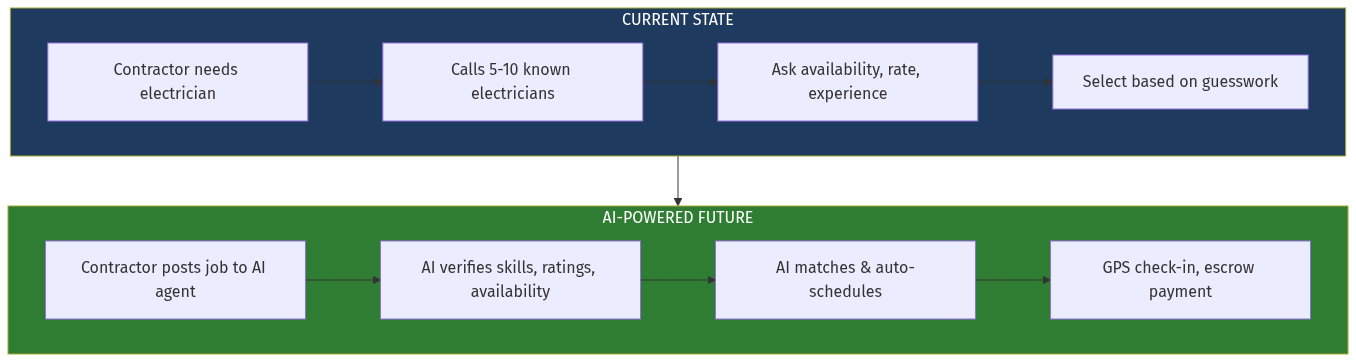
    Contractor → Calls known master → Master sends 5 workers → Hope for best
    AI-Powered Future:
    Contractor (WhatsApp) → AI Agent receives requirements 
    → AI verifies skills via video assessment 
    → AI checks background (criminal, previous employers)
    → AI matches based on location, skill, rating, availability
    → AI schedules worker (GPS check-in)
    → AI processes payment (UPI escrow → same-day release)

    AI Capabilities That Enable This

    CapabilityApplication
    Voice AI (WhatsApp)Worker onboarding and job matching via voice
    Video assessmentTrade-specific skill demonstration
    Aadhaar APIInstant identity verification
    GPS + timeAttendance without hardware
    UPI escrowPayment protection for workers
    ML matchingSkill + location + rating optimization

    Distant Domain Import

    What can we learn from other industries?

    • Ride-sharing (Uber/Ola): GPS tracking + rating system + escrow payments
    • Food delivery: Delivery partner matching + real-time tracking
    • White-collar recruitment (TraqCheck): Background verification automation
    ---

    7.

    Product Concept

    MVP Features

    For Contractors (Buyer):
  • WhatsApp job posting — "Need 2 masons for 3-storey building, Powai, 30 days, 900/day"
  • AI skill matching — Get 3-5 verified workers with ratings
  • Worker cards — Photo, verified skills, rating, past employer reviews
  • Attendance tracking — GPS check-in/check-out
  • Same-day payments — UPI transfer end of day
  • For Workers (Supplier):
  • WhatsApp registration — Voice-based onboarding
  • Skill verification — Video demo of trade skills
  • Job alerts — Notifications for matching jobs nearby
  • Rating system — Build reputation over time
  • Payment guarantee — Same-day guaranteed payment
  • Business Model

    Revenue StreamAmountNotes
    Per-hire fee5-10% of wagesInstead of 20-30% to middlemen
    Contractor subscription₹2,000-10,000/monthTiered by team size
    Verification fee₹100-200Background + skill check
    Payment floatInterestOn escrow amounts

    Diagram: AI-Powered Construction Worker Flow

    Construction Worker Flow
    Construction Worker Flow

    8.

    Development Plan

    PhaseTimelineDeliverables
    MVP8 weeksWhatsApp onboarding, basic matching, manual payment
    V112 weeksAadhaar verification, GPS attendance, UPI integration
    V216 weeksAI voice interviews, trade-specific skill tests
    Scale24 weeksMulti-city, contractor ERP integration

    Key Milestones

    • Month 2: 100 workers onboarded, 10 contractors
    • Month 4: 1,000 workers, 50 contractors, first revenue
    • Month 6: 5,000 workers, 200 contractors, proven retention
    • Month 12: 50,000 workers, 1,000 contractors, Series A ready

    9.

    Go-To-Market Strategy

    Phase 1: Mumbai MMR (Proof Point)

    • Partner with 20 mid-size contractors (₹50L-5Cr projects)
    • Onboard 500 skilled workers (masons, electricians, plumbers)
    • Demonstrate: 30-day retention vs 40% industry average

    Phase 2: Pune + Thane

    • Expand to adjacent markets
    • Add carpenters, painters, welders
    • Partner with material suppliers (they know contractors)

    Phase 3: National Scale

    • Tier 2-3 cities with construction boom
    • Government projects (PM Awas Yojana workers)
    • Gulf migration (skilled workers for Saudi/UAE projects)

    Channels

    • Contractor networks — Trusted relationships matter
    • Material suppliers — They already serve contractors
    • WhatsApp groups — Workers already there
    • RMC (Ready Mix Concrete) plants — Serve same contractors

    10.

    Revenue Model

    Unit Economics

    • CAC: ₹500 per worker, ₹2,000 per contractor
    • LTV: ₹3,000 per worker (per hire), ₹60,000 per contractor (annual)
    • Payback: 3 months

    Revenue Breakdown (Year 3)

    StreamRevenue%
    Per-hire fees₹40 Cr50%
    Subscriptions₹25 Cr31%
    Verification₹10 Cr13%
    Float income₹5 Cr6%
    Total₹80 Cr100%
    ---
    11.

    Data Moat Potential

    Proprietary Data That Accumulates

  • Skill verification records — Who can actually do what
  • Attendance patterns — Reliability scores over time
  • Wage benchmarks — Real-time market rates by skill + location
  • Contractor reputation — Payment history, project completion
  • Migration patterns — Where workers come from, go to
  • Competitive Moat

    • Network effects: More workers → more contractors → more workers
    • Data moat: Historical performance = trust
    • Escrow lock-in: Worker earnings create platform stickiness

    12.

    Why This Fits AIM Ecosystem

    This aligns with AIM.in's vision:

    • Vertical focus: Construction is a massive underserved domain
    • India-first: 70M workers, zero tech at scale
    • B2B marketplace: Contractor-to-worker matching
    • AI-native: Voice-first, WhatsApp-native approach
    • Data play: Skill verification + performance history
    Could launch as aimconstruction.in or integrate into AIM
    13.

    Pre-Mortem: Why Might This Fail?

    Steelmanning the Opposition

    Incumbents could win because:
  • Trust takes time — Contractors prefer known workers
  • Middlemen resistance — Dalals will actively sabotage
  • Quality variability — AI can't verify all skills reliably
  • Payment delays — Contractors have cash flow issues
  • Worker churn — Construction workers move between cities
  • What Would Prove This Wrong?

    • Workers refuse digital onboarding (but UPI says otherwise)
    • Contractors won't pay platform fees (but they're paying dalals 30%)
    • No differentiation from existing WhatsApp groups (but groups have no trust layer)

    ## Verdict

    Opportunity Score: 8.5/10 Why 8.5?:
    • Massive TAM ($50B+ daily wage market)
    • Zero competition at scale (Naukri/UrbanCompany don't target this)
    • Clear value for both sides
    • AI enables what was impossible before (trust via verification, payments via UPI)
    • Government support for formalization
    Risk Factors:
    • Trust building (prior exploitation by dalals)
    • Middleman resistance (but they're exploitative, so workers will embrace)
    • Quality verification reliability
    Recommendation: This is one of the top 3 underserved B2B opportunities in India. Build focus on Mumbai MMR first (high construction activity, tech-savvy contractors), prove retention metrics, then scale. The blue-collar recruitment space (70M construction workers) pairs well with the 500M general blue-collar workforce—we can expand into factories, logistics, and delivery.

    ## Sources