ResearchWednesday, April 15, 2026

AI-Powered B2B Professional Services Marketplace: The $300B Opportunity to Transform How Businesses Hire Experts

Every business needs legal help, accounting, consulting, marketing agencies, and specialized expertise. Yet 80% of B2B service hiring still happens through personal referrals, LinkedIn messages, and ad-hoc searches. AI agents can now match businesses to verified service providers instantly—eliminating the 3-week discovery process and transforming a fragmented $300B market.

7
Opportunity
Score out of 10
1.

Executive Summary

The professional services market is a $300+ billion industry where finding the right expert remains stubbornly manual. Businesses spend 2-6 weeks identifying, vetting, and negotiating with service providers. Meanwhile, excellent consultants and agencies struggle to find clients beyond their referral network.

AI agents can automate this entire workflow:

  • Instant matching — Understand requirements via natural language, match to qualified providers
  • Vetting automation — Analyze portfolios, verify credentials, check references
  • Proposal generation — Generate standardized proposals in minutes, not days
  • Quality tracking — Build reputation systems that survive provider changes
This creates a new category: AI-native professional services procurement.


2.

Problem Statement

B2B service hiring is broken:

  • Discovery friction: Finding the right provider requires 20+ hours of research
  • Quality uncertainty: Online reviews don't reflect actual deliverable quality
  • Price opacity: Businesses don't know if they're getting fair rates
  • Trust deficit: New relationships require extensive vetting
  • Repeat friction: Each new need starts the search from scratch
  • Market fragmentation: Thousands of small providers, no dominant platform for B2B
The average enterprise makes 15+ service hires per year. Multiply that by the discovery friction, and you're looking at 100+ hours wasted annually per company.
3.

Current Solutions

CompanyWhat They DoWhy They're Not Solving It
UpworkFreelance marketplaceGig-focused, not B2B; race-to-bottom pricing
LinkedInProfessional networkDiscovery is manual; no service marketplace
ClutchB2B service reviewsReviews are easily gamed; limited coverage
GoodFirmsAgency directorySEO-focused, not AI-native
YelpLocal servicesConsumer-focused, not B2B
Current solutions suffer from:
  • SEO gamesmanship over genuine quality
  • No AI-powered matching
  • Consumer/gig focus vs. B2B relationships
  • Manual discovery processes
  • No ongoing relationship management

4.

Market Opportunity

  • Global professional services market: $300B+ (2026)
  • B2B segment: $180B+
  • Addressable market (US/India/Europe): $90B+
  • Growth drivers:
1. Remote work enables global talent access 2. AI makes matching economically viable at scale 3. Enterprises demand faster procurement 4. SMBs need affordable expert access Why now:
  • LLMs can understand complex service requirements
  • Video-first meetings reduce trust-building friction
  • Global talent is more accessible than ever
  • Payment infrastructure is mature (Stripe, Wise)

  • 5.

    Gaps in the Market

  • No AI-native B2B matching — Current platforms use search, not understanding
  • No cross-category intelligence — Legal doesn't talk to consulting doesn't talk to marketing
  • No relationship memory — Each hiring starts from zero
  • No quality prediction — Reviews are after-the-fact, not predictive
  • No auto-vetting — Credentials verification is manual
  • No standardized scoping — Proposals vary wildly in format

  • 6.

    AI Disruption Angle

    AI transforms service hiring fundamentally:

    What AI Can Do Now

  • Requirement understanding — Parse vague needs into structured specs
  • Multi-source verification — Cross-reference credentials across platforms
  • Portfolio analysis — Evaluate work samples for relevance
  • Rate benchmarking — Compare against market data
  • Reference synthesis — Transform random reviews into signals
  • Proposal generation — Create templated, comparable proposals
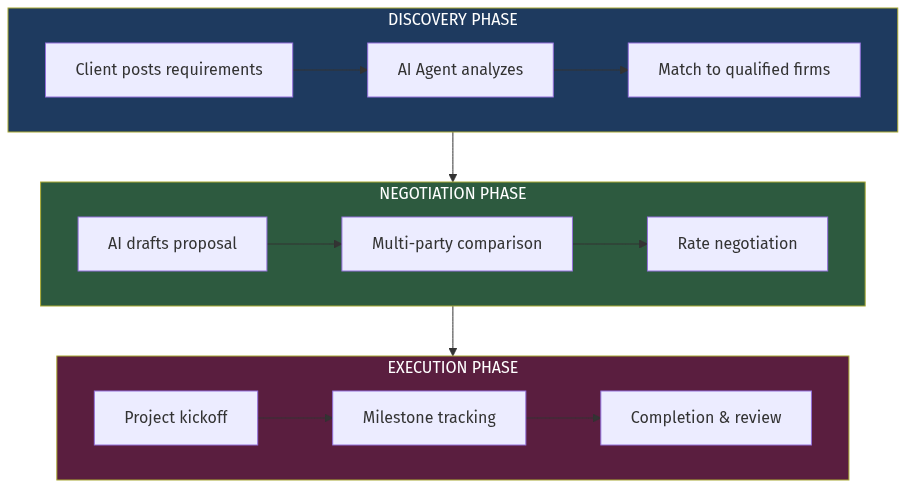
  • The Agent Workflow

    Professional Services AI Architecture
    Professional Services AI Architecture

    7.

    Product Concept

    An AI-powered marketplace where:

  • Natural language posting — "We need a fintech regulatory lawyer for RBI compliance, budget $5-10K"
  • Instant matching — AI matches to 3-5 qualified firms/providers
  • Vetting automation — AI verifies credentials, analyzes portfolios, checks references
  • Proposal comparison — Standardized proposals for apples-to-apples comparison
  • Engagement tracking — Milestone-based payments, quality scoring
  • Relationship memory — Next need remembers past performance
  • Key Features

    FeatureDescription
    AI ScoperConverts vague needs to detailed requirements
    Provider GraphNetwork of verified professionals across categories
    Match EngineMulti-factor matching (expertise, availability, rate, rating)
    Vet AIAutomated credential and reference checking
    Proposal OSTemplate-based proposal generation
    Engage TrackerMilestone and payment management
    ---
    8.

    Development Plan

    PhaseTimelineDeliverables
    MVP8 weeksSingle category (legal), 50 providers, basic matching
    V116 weeksMulti-category (legal, accounting, consulting), 500 providers
    V224 weeksFull AI matching, proposal automation, payments
    V336 weeksEnterprise features, API, white-label
    ---
    9.

    Go-To-Market Strategy

    Phase 1: Founder-Led Sourcing

    • Recruit 50 high-quality providers per category personally
    • Offer preferential placement for early adopters
    • Build case studies from real engagements

    Phase 2: Category Expansion

    • Add accounting, consulting, marketing, IT services
    • Beta with 10 SMBs as "founding customers"
    • Build demand-side waitlist

    Phase 3: Network Effects

    • Provider quality drives client acquisition
    • Client volume drives provider desperation
    • Achieve critical mass in target verticals
    Initial focus:Startup-legal (funding, compliance) → SMB-accounting (tax, bookkeeping)
    10.

    Revenue Model

    • Freemium: 1 free match (provider evaluates)
    • Pro: $29/match for verified providers
    • Enterprise: $499/month unlimited matches + dedicated support
    • Featured: $199/week for top placement
    • Success fee: 5% on first engagement (optional)

    11.

    Data Moat Potential

    • Provider graph: Relationships, past collaborators, specializations
    • Outcome data: What matches worked, what didn't
    • Rate benchmarks: Real-time market pricing
    • Quality signals: Performance across engagements
    • Satisfaction tracking: Long-term client happiness

    12.

    Why This Fits AIM Ecosystem

    This opportunity aligns perfectly with AIM.in's B2B focus:

    • Target customers: SMBs, startups, enterprises
    • Revenue model: Transaction + subscription hybrid
    • Repeat usage: Every business needs multiple services
    • India play: Massive_services market (legal, accounting, IT)
    For the Indian market specifically:
    • 10M+ SMBs need affordable professional services
    • Regulatory complexity drives demand (GST, RBI, SEBI compliance)
    • Fragmented CA, lawyer markets are ripe for matching
    • WhatsApp-first communication suits Indian business culture

    13.

    Mental Model Analysis

    ZEROTH PRINCIPLES: The assumption that "you need to meet to trust" is breaking. AI can build trust through data signals (credentials, references, portfolio analysis) without in-person meetings. INCENTIVE MAPPING: Existing platforms profit from volume, not quality. They don't want to filter because quality filtering reduces GMV. AI can profit from quality because it reduces transaction costs. FALSIFICATION PRE-MORTEM: Why would 5 funded startups fail here?
  • Trust paradox — Businesses still prefer human relationships for high-value work
  • Quality verification — AI can't actually verify deliverable quality before engagement
  • Provider resistance — Top providers don't need the platform; they get referrals
  • Enterprise procurement — Big companies use RFP processes, not marketplaces
  • Category complexity — Legal and consulting require different matching than creative work
  • STEELMANNING: Upwork has 20M+ freelancers and $1B+ revenue. LinkedIn has the professional graph. Replacing them requires 10x better matching, not incrementally better. ANOMALY HUNTING:
    • What's strange? LinkedIn is the professional network but doesn't monetize service discovery
    • What's missing? A platform that verifies expertise, not just identity
    • What should be here? Trust scores that predict deliverable quality

    ## Verdict

    Opportunity Score: 7/10

    This is a large, real market with clear pain. The timing is right because:

  • LLMs can understand complex service requirements
  • Remote work normalizes hiring strangers
  • Global talent access is now viable
  • Risk: Network effects favor incumbents. Top providers get clients via referral. Mitigation: Focus on mid-market (not top-tier) where matching adds value; build in categories where fragmentation is extreme. India-specific advantage: Massive underserved SMB market + WhatsApp-native workflow + regulatory complexity = natural fit.

    ## Sources