ResearchThursday, April 16, 2026

AI-Powered B2B Restaurant Supplies & Food Distribution: The Next Unstructured-to-Structured Play

India's Rs 8 lakh crore food & restaurant industry runs on WhatsApp and Excel. AI agents can automate procurement, inventory prediction, and supplier discovery — creating the first structured B2B food supply network at scale.

1.

Executive Summary

India's restaurant and food service industry is massive — worth approximately Rs 8 lakh crore (~$100B) — yet 90% of B2B transactions happen over WhatsApp, phone calls, or physical markets. There is no Amazon-style marketplace for restaurant supplies. No structured catalog. No price discovery. No automated reordering.

This creates a fundamental opportunity: build AI agents that understand restaurant procurement workflows and automate the entire supply chain — from menu planning to ingredient sourcing to predictive inventory.

The opportunity is compelling because:

  • Fragmentation: 80 lakh+ restaurants, dhabas, cloud kitchens, and hotel chains
  • High frequency: Daily/weekly ordering cycles create recurring revenue potential
  • Price sensitivity: 30-40% of costs are ingredients — buyers actively negotiate
  • Trust gap: No verified supplier ratings, no quality guarantees
  • Wholesale markets: Each city has "mandis" for produce, "markets" for dry goods — entirely offline
  • Cold chain: Perishables require specialized logistics, creating margin opportunities
AI agents can become the intelligent procurement layer — understanding what a restaurant needs based on past orders, seasonality, foot traffic, and menu — and automatically sourcing, comparing prices, and placing orders.


2.

Problem Statement

Here's how restaurant procurement actually works in India:

The Current Workflow (Manual & Fragmented)

  • Chef/Owner checks inventory — "we're running low on tomatoes, onions, dal"
  • Phone call or WhatsApp to known supplier: "kitne ke denge 50 kg tomatoes?"
  • Supplier quotes price (varies daily based on market rates)
  • Negotiation — "bhaiya, itna nahi, kam karo"
  • Order confirmed — "kal subah deliver karwana hai"
  • Delivery — often with quality issues ("paisa diya, ye level tomatoes?")
  • Payment — cash on delivery, or NET-15/30 for known suppliers
  • No record — Excel sheets if at all, mostly mental tracking
  • The Pain Points

    Pain PointImpactFrequency
    Price opacityPay 15-30% premium vs market rateDaily
    Quality uncertaintyReceive sub-standard produce, can't returnWeekly
    Time consumption2-4 hours/day on procurement callsDaily
    No inventory predictionStockouts or wastage (15-20% spoilage)Weekly
    Limited supplier discoveryCan't find new suppliers, stuck with currentMonthly
    No consolidated orderingMultiple calls to multiple suppliersDaily
    **Payment frictionCash-heavy, credit terms undefinedDaily

    Who Experiences This?

    • Cloud kitchens (Swiggy/Zomato-backed) — high volume, thin margins
    • Hotel chains — need consistent quality, bulk ordering
    • Dhabas & local restaurants — price-sensitive, value-driven
    • Corporate cafeterias — high volume, predictable menu cycles
    • Event caterers — bulk ordering, irregular patterns

    3.

    Current Solutions

    CompanyWhat They DoWhy Not Solving It
    ZapbuildRestaurant management SaaSFocus on front-office, not procurement
    Kitchen UnitedCloud kitchen infrastructureGhost kitchen focus, not supply chain
    Flipkart WholesaleB2B general merchandiseNot specialized for restaurants
    JumbotailB2B grocery marketplaceConsumer-focused, not restaurant-specific
    LiciousMeat delivery (B2C)Only meat, not full supply chain
    WaycoolAgricultural supply chainFarm-to-retail, not restaurant-focused
    Country DelightDairy & essentialsB2C consumer, not restaurants

    Market Gap Analysis

    What's Missing:
  • Restaurant-specific catalog — ingredients, packaging, equipment
  • Real-time price discovery — daily market rates transparency
  • AI-powered predictive ordering — based on foot traffic, seasonality
  • Quality-verified suppliers — ratings, reviews, dispute resolution
  • Consolidated logistics — multi-supplier delivery unified
  • Credit & payments — digital credit terms, invoice financing
  • Menu cost optimization — AI suggests cheaper alternatives

  • 4.

    Market Opportunity

    Market Size

    • India Food Service Industry: Rs 8 lakh crore (~$100B)
    • Raw Material Sourcing: ~Rs 3-4 lakh crore (40% of industry)
    • Addressable Market: Rs 50,000 crore (1.5% capture by Year 5)
    • TAM by Category:
    - Fresh produce (vegetables, fruits): Rs 1.5 lakh crore - Staples (rice, wheat, pulses): Rs 80,000 crore - Meat & seafood: Rs 50,000 crore - Dairy & eggs: Rs 40,000 crore - Packaging & disposables: Rs 15,000 crore - Spices & condiments: Rs 10,000 crore

    Growth Drivers

  • Restaurant count growth: 12-15% YoY (cloud kitchens driving 30% growth)
  • Organized sector shift: Unorganized to organized (currently 65% unorganized)
  • Digital adoption: UPI for B2B payments, WhatsApp for communication
  • Quality focus: Post-COVID hygiene standards, customer expectations
  • Margin pressure: Restaurants need 8-12% margin improvement
  • Why Now

    • COVID forced digital adoption: Restaurants learned to use WhatsApp, QR menus, delivery apps
    • Cloud kitchen explosion: 5,000+ cloud kitchens in major cities, all needing supply chains
    • UPI for B2B: Digital payments finally viable for small transactions
    • LLMs for domain understanding: AI can now understand restaurant-specific procurement
    • Logistics maturity: Cold chain infrastructure improving, last-mile delivery matured
    • WhatsApp ubiquity: Every supplier and buyer on WhatsApp = integration point

    5.

    Gaps in the Market

    AI/Agent Opportunity Gaps

    GapCurrent StateAI Solution
    Procurement time2-4 hrs/day manualAI agent handles all ordering
    Price discoveryManual calling, opacityReal-time market integration
    Inventory waste15-20% spoilagePredictive ordering based on foot traffic
    Supplier discoveryWord-of-mouthAI-matched suppliers based on requirements
    Quality disputesHe-said-she-saidAI-documented quality checks, photo evidence
    Credit accessCash on deliveryAI-assessed credit, invoice factoring
    Menu engineeringIntuition-basedAI cost optimization, substitution suggestions

    Structural Gaps

  • No B2B Amazon for restaurants — Amazon/Flipkart don't specialize
  • No quality standardization — "A-grade" tomatoes means different things
  • No price transparency — daily rates vary by 20-30%
  • No consolidated logistics — each supplier does own delivery
  • No working capital solutions — restaurants operate on thin margins
  • No data-driven decisions — most restaurants run on Excel/mental models

  • 6.

    AI Disruption Angle

    How AI Agents Transform Restaurant Procurement

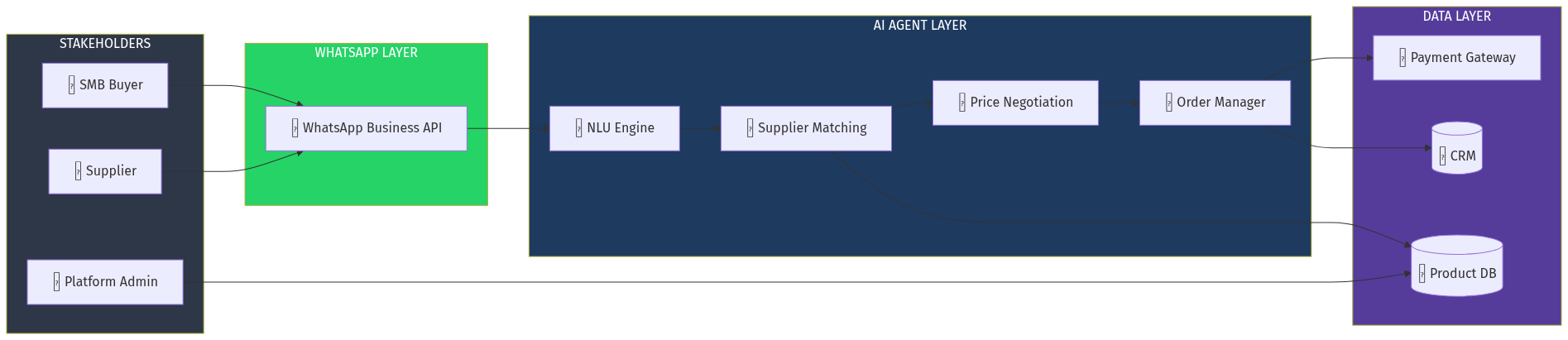
    AI Agent Architecture
    AI Agent Architecture

    #### The AI Agent Workflow

    Phase 1: Understanding (NLP)
    • Agent reads WhatsApp/calls from chef: "We need tomatoes, onions, dal for weekend"
    • AI understands quantity, quality, timeline, budget
    • Cross-references with restaurant's menu and historical orders
    Phase 2: Sourcing (Market Matching)
    • Agent queries multiple suppliers simultaneously
    • Compares prices, ratings, delivery times
    • Applies business rules: "only suppliers with 4+ rating"
    Phase 3: Recommendation (Decision Support)
    • Agent presents options: "Tomato Option A: Rs 25/kg (trusted), Option B: Rs 22/kg (new supplier)"
    • Shows price history, quality scores
    • Buyer approves with one WhatsApp message
    Phase 4: Ordering (Automation)
    • Agent places order with supplier
    • Confirms delivery slot
    • Sends payment link via UPI
    Phase 5: Tracking (Updates)
    • Agent tracks order status: "Out for delivery, ETA 2pm"
    • On delivery, asks for quality photo verification
    • Logs everything for future reference
    #### Key AI Capabilities Required
  • Restaurant-specific NLP — Understanding chef lingo ("dhaniya fresh, tomatoes ripe")
  • Demand forecasting — Predicting order volume from foot traffic, events, weather
  • Supplier matching — ML-based matching of requirements to supplier capabilities
  • Price optimization — Real-time market rate analysis
  • Quality scoring — Historical quality data, photo-based verification
  • Conversational ordering — Natural language via WhatsApp

  • 7.

    Product Concept

    Platform: RestaurantOS (B2B Food Supply)

    #### Core Features

  • AI Procurement Agent
  • - Natural language ordering via WhatsApp - "Book my usual vegetables for tomorrow" — agent handles rest - Auto-reorder based on inventory levels
  • Supplier Marketplace
  • - Verified supplier profiles with ratings - Real-time pricing from multiple vendors - Quality scores based on historical data
  • Smart Inventory
  • - IoT integration for smart stock tracking - Waste prediction algorithms - Auto-reorder triggers
  • Price Intelligence
  • - Daily market rates for key commodities - Price trend analysis - Buy/sell recommendations
  • Quality Assurance
  • - Photo-based delivery verification - Dispute resolution workflow - Supplier quality scoring
  • Financial Services
  • - Digital credit terms - Invoice factoring - Bulk payment discounts

    #### User Journey

    StepUser ActionSystem Response
    1Restaurant registersOnboarding, menu setup, supplier matching
    2Chef sends WhatsApp "need supplies"AI agent parses, confirms order
    3Agent quotes optionsMulti-supplier comparison shown
    4Chef approvesOrder placed, payment processed
    5Delivery trackingReal-time updates
    6Quality verificationPhoto upload, rating
    7Payment/settlementInvoice generated, credit applied
    ---
    8.

    Development Plan

    Phase 1: MVP (Weeks 1-8)

    Objective: Validate demand, prove AI can reduce procurement time
    DeliverableTimelineDescription
    WhatsApp AI AgentWeek 2-4NLP agent for order taking
    Supplier integrationWeek 3-5Connect 50 suppliers in 2 cities
    Basic ordering UIWeek 4-6Web dashboard for order management
    Pilot with 20 restaurantsWeek 7-8Beta in Hyderabad
    Metrics to Prove:
    • 50+ orders/day
    • 20% time reduction in procurement
    • 10% cost savings

    Phase 2: Scale (Weeks 9-20)

    Objective: Expand to 5 cities, add AI intelligence
    DeliverableTimelineDescription
    Price intelligenceWeek 9-12Market rate aggregation
    Inventory predictionWeek 10-14ML-based forecasting
    Multi-city expansionWeek 12-20Bangalore, Chennai, Mumbai, Delhi
    Supplier marketplaceWeek 14-18Self-service supplier onboarding
    Quality scoringWeek 16-20Photo verification, ratings
    Metrics to Prove:
    • 500+ restaurants
    • 10% GMV take rate
    • 15% cost savings per restaurant

    Phase 3: Network Effects (Weeks 21-40)

    Objective: Build dominant position, expand to adjacent categories
    DeliverableTimelineDescription
    Financial servicesWeek 21-28Credit, factoring
    Warehouse networkWeek 24-32Consolidation centers
    Restaurant franchisingWeek 28-36Franchise supply model
    Export/importWeek 32-40Specialty ingredients
    Metrics to Prove:
    • 5000+ restaurants
    • Rs 500+ GMV
    • 8% EBITDA margin

    9.

    Go-To-Market Strategy

    Initial Targeting

    Focus cities: Hyderabad (proven market), Bangalore (tech-savvy), Mumbai (scale) Initial segment: Cloud kitchens
    • Already digitally native
    • High ordering frequency
    • Margin-sensitive
    • Willing to experiment

    Launch Strategy

    ChannelTacticRationale
    Cloud kitchen partnershipsPartner with 10 large cloud kitchen operatorsVolume, feedback, case studies
    WhatsApp-firstDon't build app, start on WhatsAppRestaurant owners already on WhatsApp
    Supplier recruitmentRecruit 20 suppliers per citySupply-side liquidity before demand
    Food park targetingTarget food parks with 50+ kitchensConcentrated demand
    Restaurant associationsPartner with local associationsTrust, distribution
    Referral programincentivize existing restaurants to referLow CAC, high trust

    Growth Flywheel

  • Get restaurants → Offer AI procurement benefits
  • Get suppliers → Offer volume, guaranteed payment
  • Lower prices → More restaurants join
  • More data → Better AI, more value
  • Network effects → Dominant position
  • Pricing Model

    Revenue StreamModelTake Rate
    Product markupMark up on supplier prices8-15%
    SubscriptionSaaS fee for AI featuresRs 2,000-10,000/month
    Data servicesMarket intelligence reportsRs 5,000/month
    Financial servicesInterest on credit12-18% APR
    AdvertisingFeatured suppliersRs 50,000/month
    ---
    10.

    Revenue Model

    Revenue Streams

  • Transaction Revenue (Primary)
  • - 8-15% markup on orders - Target: Rs 500 GMV by Year 3 - Revenue potential: Rs 40,000 crore at maturity
  • SaaS Subscriptions
  • - Basic: Rs 2,000/month (AI ordering) - Pro: Rs 5,000/month (inventory + AI) - Enterprise: Rs 10,000/month (full suite) - Target: 5000 restaurants - Revenue: Rs 30 crore ARR at scale
  • Financial Services
  • - Invoice factoring (15% of order value) - Working capital loans (12-18% APR) - Target: 30% of GMV uses credit - Revenue: Rs 50 crore at scale
  • Data & Intelligence
  • - Market price reports - Supplier benchmarking - Menu cost optimization - Revenue: Rs 10 crore at scale

    Unit Economics

    MetricTarget
    CACRs 5,000
    LTVRs 1,50,000
    LTV:CAC30:1
    Payback3 months
    Gross margin12-18%
    Net margin5-8%
    ---
    11.

    Data Moat Potential

    Proprietary Data Accumulation

  • Supplier data
  • - Pricing history - Quality scores - Delivery reliability - Product availability
  • Restaurant data
  • - Ordering patterns - Menu composition - Seasonal demand - Price sensitivity
  • Market data
  • - Real-time commodity prices - Regional variations - Supply-demand dynamics
  • Transaction data
  • - Payment behavior - Credit worthiness - Lifetime value

    Moat Strength

    Data TypeMoat StrengthDuration
    Supplier quality scoresHigh2-3 years to build
    Restaurant ordering patternsVery High5+ years
    Real-time price intelligenceMedium1-2 years
    AI training dataVery HighPerpetual

    Competitive Moat

    • Network effects: More restaurants → better prices → more restaurants
    • Data moat: Proprietary transaction data trains better AI
    • Supplier relationships: Exclusive partnerships
    • Brand trust: Quality guarantees, dispute resolution

    12.

    Why This Fits AIM Ecosystem

    Integration Points

  • WhatsApp-first: Aligns with existing WhatsApp commerce play
  • AIM.in vertical: Could become "AIM.restaurants" vertical
  • Domain portfolio: restaurant.in, foodsupplies.in, cloudkitchen.in (potential owned domains)
  • B2B DNA: Builds on B2B marketplace learnings
  • AI agent expertise: Leverages existing AI capabilities
  • Cross-Selling Opportunities

    • Restaurant financing: Partner with AIM financial services
    • POS integration: Connect with existing restaurant POS systems
    • Inventory IoT: Partner with IoT providers
    • Logistics: Integrate with cold chain providers

    Domain Assets to Build

    • restaurant.supply
    • food.wholesale
    • chef.store
    • kitchenhub.in

    ## Verdict

    Opportunity Score: 8.5/10

    This is a high-value, high-frequency B2B marketplace opportunity with clear AI augmentation potential. The fragmented nature of India's restaurant supply chain, combined with the prevalence of WhatsApp as the primary communication channel, creates a perfect storm for AI-powered disruption.

    Strengths

    • Massive addressable market (Rs 3-4 lakh crore)
    • High-frequency transactions (daily/weekly)
    • Clear pain points (procurement time, price opacity)
    • WhatsApp-native distribution
    • AI can significantly reduce manual work

    Risks & Mitigations

    RiskLikelihoodMitigation
    Supplier resistanceMediumOffer guaranteed payment, volume
    Price transparencyHighStart with value-add, not full transparency
    Quality disputesMediumPhoto verification, escrow
    Logistics complexityHighPartner, don't build initially
    Restaurant churnMediumHigh switching costs via AI learning

    Steelman (Why incumbents might win)

  • Existing B2B players (Jumbotail, Waycool) could add restaurant focus
  • Restaurant SaaS players (Zapbuild) could extend to procurement
  • Swiggy/Zomato could verticalize into supplies
  • Supplier cartels could resist platform adoption
  • Logistics players could integrate backward
  • Pre-Mortem (Why this might fail)

    • Chicken-and-egg: No suppliers without restaurants, no restaurants without suppliers
    • Price war: Competitors subsidize to win, burn cash
    • Quality failures: Bad delivery = churn, negative network effects
    • Capital intensity: Working capital for inventory, credit facilities

    Recommendation

    This is a Tier 1 opportunity — worth pursuing with dedicated resources. The key success factors:

  • Start with 2-3 cities, prove unit economics
  • Focus on cloud kitchens as initial segment
  • Build AI agent as primary interface (not app)
  • Don't build logistics — partner
  • Add financial services as profit driver

  • ## Sources